Unraveling the Mystery: Deciphering the Contrast Between Hardware and Software
In the realm of technology, two fundamental pillars underpin every digital experience: hardware and software. While often spoken of in the same breath, they represent distinct yet intricately linked facets of computing. Understanding their individual characteristics, their symbiotic relationship, and their evolutionary journey is crucial for anyone seeking to comprehend the true essence of modern technology. This exploration delves into the core definitions, functions, and dynamic interplay of these essential elements, revealing how they collaboratively bring the digital world to life.
Contents
- 0.1 Understanding the Basics: What is Hardware and Software?
- 0.2 The Role of Hardware in Computing: Exploring the Physical Components
- 0.3 The Function of Software: How Programs and Applications Drive Technology
- 0.4 Contrasting Characteristics: Examining the Differences Between Hardware and Software
- 0.5 Interdependence and Interaction: How Hardware and Software Work Together
- 0.6 The Evolution of Hardware and Software: From Early Innovations to Modern Technology
- 0.7 The Future of Technology: Anticipating the Impact of Advancements in Hardware and Software
- 1 FAQs
- 1.1 1. What is the difference between hardware and software?
- 1.2 2. How do hardware and software work together?
- 1.3 3. What are some examples of hardware and software?
- 1.4 4. How has the evolution of hardware and software impacted technology?
- 1.5 5. What can we anticipate in the future of hardware and software technology?
Understanding the Basics: What is Hardware and Software?
Before dissecting their differences, a clear conceptualization of each is paramount. Imagine a human body; the physical form—bones, organs, muscles—is analogous to hardware. The thoughts, emotions, and instructions that dictate the body’s actions are akin to software. This foundational analogy provides a starting point for a more detailed understanding.
Hardware: The Tangible Foundation
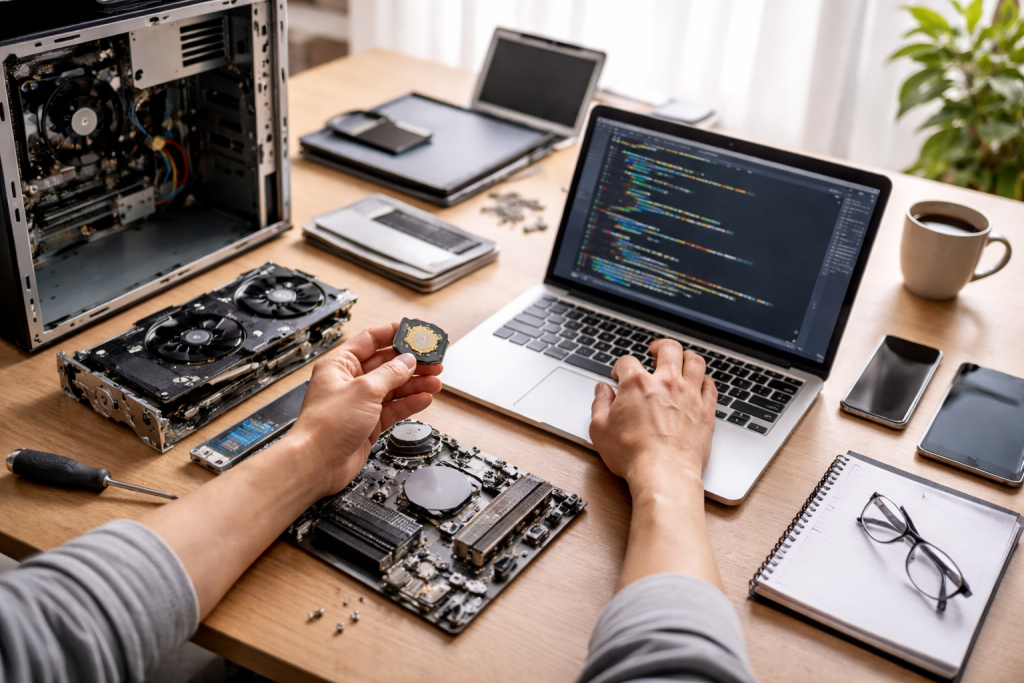
Hardware refers to the physical components of a computer system. These are the parts you can see and touch, the tangible machinery that enables computational processes. From the smallest microchip to the largest server rack, hardware forms the physical infrastructure upon which all digital operations are built. It encompasses a vast array of components, each with a specific role in processing, storing, and transmitting data. Without hardware, software would have no platform to run on, no circuits to execute its instructions, and no memory to store its data. It’s the silent, robust engine that powers the entire digital world, from personal devices to global networks.
Software: The Intangible Intelligence
Conversely, software is the collection of instructions, data, or programs that tell hardware what to do. It’s the invisible force that orchestrates the actions of the physical components. Think of it as the brain and nervous system of a computer. Software has no physical form; it exists as digital code, a series of commands designed to perform specific tasks. Its essence lies in its ability to dictate behavior, to transform raw electrical signals into meaningful information, and to empower users to interact with their devices in countless ways. Without software, hardware would merely be an inert collection of components, devoid of purpose or functionality.
The Role of Hardware in Computing: Exploring the Physical Components
Hardware is the backbone of any computing system, a complex tapestry of interconnected physical elements. Each component plays a vital role, working in concert to execute the instructions provided by software.
The Central Processing Unit (CPU): The Brain of the Operation
At the core of every computer lies the Central Processing Unit, or CPU. Often referred to as the “brain,” the CPU is responsible for executing instructions and performing calculations. It processes data, manages the flow of information, and largely determines the overall speed and performance of the system. Its clock speed, measured in gigahertz, indicates how many cycles it can perform per second, directly impacting how quickly tasks are completed. Modern CPUs are incredibly complex, containing billions of transistors that switch on and off at astonishing speeds, converting electrical signals into logical operations.
Memory (RAM and ROM): The System’s Short and Long-Term Recall
Memory in hardware comes in various forms, each serving a distinct purpose. Random Access Memory (RAM) is a volatile form of memory, meaning it requires power to maintain the stored information. It acts as the computer’s short-term working memory, actively holding data and program instructions that the CPU needs to access quickly. The more RAM a system has, the more applications it can run simultaneously without experiencing slowdowns. Read-Only Memory (ROM), on the other hand, is non-volatile and stores essential boot-up instructions that the computer needs to start. This information is permanently etched onto chips and remains even when the power is off.
Storage Devices: Preserving Digital Assets
Storage devices are crucial for permanently saving data, ensuring that information persists even when the computer is turned off. Hard Disk Drives (HDDs) traditionally used spinning platters and read/write heads to store data magnetically. Solid State Drives (SSDs) represent a newer technology, utilizing flash memory for significantly faster access speeds and greater durability due to the absence of moving parts. External storage devices like USB drives and external hard drives offer portability and additional capacity, allowing users to back up and transfer their information effortlessly. The capacity and speed of storage devices directly influence how much data can be kept and how quickly it can be retrieved.
Input/Output Devices: The Bridge to Interaction
Input/output (I/O) devices facilitate communication between the user and the computer, and between the computer and the external world. Input devices, such as keyboards, mice, touchscreens, and microphones, allow users to feed information and commands into the system. Output devices, including monitors, printers, and speakers, enable the computer to present information back to the user. These crucial interfaces translate human actions into machine-readable data and vice-versa, making interaction with the digital realm intuitive and accessible.
The Function of Software: How Programs and Applications Drive Technology
Software, the intangible counterpart to hardware, breathes life into the physical components, transforming them into functional tools. It’s the set of instructions that dictates every action, every calculation, and every display on the screen.
Operating Systems: The Master Conductor
The operating system (OS) is perhaps the most fundamental type of software. It’s the master conductor that manages all of the computer’s hardware and software resources. Examples include Windows, macOS, Linux, Android, and iOS. The OS provides a platform for other applications to run, handles memory management, processes input and output, and manages file systems. Without an operating system, the computer would be an unusable collection of parts. It acts as the intermediary between the hardware and the user, abstracting away complex technical details and providing a user-friendly interface.
Application Software: Tools for Specific Tasks
Application software, often simply called “apps,” refers to programs designed to perform specific tasks for the user. This vast category encompasses everything from word processors and web browsers to video games and graphic design suites. Each application is developed to address a particular need, providing specialized functionalities that enhance productivity, entertainment, or communication. They interact with the operating system, which in turn communicates with the hardware to execute the application’s commands. The diversity of application software allows users to customize their computing experience to an unprecedented degree.
Programming Software: Building the Digital World
Programming software provides developers with the tools to create, debug, and maintain other software applications. This includes compilers, interpreters, debuggers, and integrated development environments (IDEs). These tools allow programmers to write code in various programming languages, translate that code into machine-readable instructions, identify and fix errors, and ultimately build the vast array of software that powers our digital world. Without programming software, the creation and evolution of new applications would be impossible. It’s the foundational layer for creating all other forms of software.
Contrasting Characteristics: Examining the Differences Between Hardware and Software
The distinctions between hardware and software, while seemingly intuitive, bear closer examination to fully appreciate their unique roles and limitations.
Tangibility vs. Intangibility
The most apparent difference lies in their physical nature. Hardware is tangible; it has a physical presence and can be touched, seen, and manipulated. A circuit board or a monitor are clear examples. Software, conversely, is intangible; it exists as a series of instructions or data, without any physical form. You cannot pick up a word processing document in the same way you can pick up a hard drive. This fundamental distinction dictates how they are stored, transported, and interacted with.
Failure Modes and Maintenance
Hardware typically fails due to physical wear and tear, manufacturing defects, or environmental factors like heat or power surges. When hardware breaks, it often requires physical repair or replacement. Software, on the other hand, does not “wear out.” It fails due to bugs, logical errors in its code, or compatibility issues. Software “bugs” are typically fixed through patches, updates, or complete reinstallation, not physical repair. Maintenance for hardware often involves cleaning, replacing parts, or upgrading components, while software maintenance focuses on debugging, updating, and improving code.
Development and Replication
Developing hardware is a complex, capital-intensive process involving engineering, manufacturing, and supply chains. Each physical unit must be produced individually. Once created, replicating hardware requires a manufacturing process. Software development, while also complex, involves writing code and algorithms. Once a piece of software is created, it can be replicated infinitely at virtually no cost (excluding licensing and distribution expenses) simply by copying the digital files. This ease of replication is a defining characteristic of software and a key driver of its widespread dissemination.
Interdependence and Interaction: How Hardware and Software Work Together
Despite their distinct characteristics, hardware and software are inextricably linked. They form a synergistic relationship, each dependent on the other to function effectively. Neither can truly exist or be useful in isolation.
The Execution Cycle: A Continuous Loop
The interaction between hardware and software is a continuous cycle. Software provides instructions to the CPU, which then performs operations on data stored in memory or retrieved from storage devices. The results of these operations are then relayed back through the software to output devices, or stored for later use. This intricate dance of instruction fetching, decoding, execution, and writing back results forms the core of every computational process. The efficiency of this cycle is dictated by the capabilities of both the hardware and the optimize software.
Drivers and APIs: Bridging the Divide
To facilitate seamless communication, specific software components act as intermediaries. Device drivers are specialized software programs that enable the operating system to interact with specific hardware components, such as printers, graphics cards, or network adapters. Application Programming Interfaces (APIs) provide a standardized way for different software components to communicate with each other, defining methods and protocols for interaction. These crucial elements bridge the gap between the physical and the logical, ensuring that hardware understands software’s commands and vice-versa.
The Evolution of Hardware and Software: From Early Innovations to Modern Technology
The history of computing is a testament to the remarkable evolution of both hardware and software, each pushing the boundaries of the other in a perpetual cycle of innovation.
Early Stages: Vacuum Tubes and Machine Code
Early computers were massive machines built with vacuum tubes, characterized by their immense size, heat generation, and limited processing power. Programming was done in machine code, a low-level language directly understood by the hardware, which was incredibly laborious and prone to errors. Software was rudimentary, often custom-built for specific hardware and tasks, and not easily transferable. The focus was on simply making the machines work.
Miniaturization and High-Level Languages
The invention of transistors and integrated circuits ushered in an era of miniaturization, leading to smaller, faster, and more powerful computers. This hardware revolution enabled the development of higher-level programming languages like Fortran and COBOL, which were easier for humans to understand and use. This made software development more accessible and efficient, leading to a proliferation of applications and a gradual shift from batch processing to interactive computing. The hardware was becoming more powerful, and software was beginning to unlock that power.
The Rise of Personal Computing and the Internet
The 1980s saw the advent of personal computers, bringing computing power to individuals. This was fueled by innovations in microprocessors and the development of intuitive operating systems like macOS and Windows. The subsequent explosion of the internet in the 1990s revolutionized communication and access to information, creating a demand for increasingly sophisticated software applications – web browsers, email clients, and online services. Hardware continued to become more powerful and affordable, while software became more user-friendly and feature-rich.
Mobile Computing and Cloud Revolution
The 21st century has witnessed the pervasive rise of mobile computing with smartphones and tablets, driven by ever-smaller, more powerful, and energy-efficient hardware. Concurrently, cloud computing has transformed how software is delivered and accessed, moving away from local installations to services delivered over the internet. Both hardware and software are now defined by connectivity, mobility, and sophisticated user interfaces, with artificial intelligence and machine learning increasingly being integrated into both.
The Future of Technology: Anticipating the Impact of Advancements in Hardware and Software
The trajectory of technological progress suggests an accelerating pace of innovation in both hardware and software, promising a future ripe with transformative possibilities.
Quantum Computing and Neuromorphic Hardware
Future hardware advancements are likely to include quantum computers, which promise to solve problems currently intractable for even the most powerful classical computers, particularly in fields like materials science and drug discovery. Neuromorphic hardware, inspired by the structure of the human brain, offers the potential for incredibly energy-efficient and powerful AI processing directly on chips. These advancements will redefine the very limits of computation, enabling entirely new paradigms of software development.
Artificial Intelligence and Advanced Algorithms
Software will continue to be reshaped by the relentless progress in artificial intelligence and machine learning. More sophisticated algorithms will enable increasingly intelligent virtual assistants, autonomous systems, and predictive analytics. The integration of AI into everyday applications will make technology more intuitive, personalized, and capable of understanding complex human requests. This will lead to software that can anticipate needs, learn from interactions, and perform tasks with unprecedented efficiency.
Seamless Integration and Ubiquitous Computing
The future points towards an even more seamless integration of hardware and software, blurring the lines between physical devices and digital experiences. Wearable technology, smart homes, and the Internet of Things (IoT) will intertwine hardware sensors and embedded software to create environments that are context-aware and responsive to human needs. We can expect a future where computing is not just about devices, but about an intelligent layer woven into the fabric of our everyday lives, driven by increasingly powerful and interconnected hardware orchestrated by ever-more sophisticated software. This convergence will redefine how we live, work, and interact with the world around us.
FAQs
1. What is the difference between hardware and software?
Hardware refers to the physical components of a computer or electronic device, such as the motherboard, CPU, and hard drive, while software refers to the programs and applications that run on the hardware, such as operating systems, word processors, and web browsers.
2. How do hardware and software work together?
Hardware provides the physical platform for software to run, while software utilizes the hardware’s capabilities to perform tasks and functions. They are interdependent, with hardware providing the necessary infrastructure for software to operate, and software driving the functionality of the hardware.
3. What are some examples of hardware and software?
Examples of hardware include a computer’s central processing unit (CPU), monitor, keyboard, and mouse, while examples of software include operating systems like Windows or macOS, as well as applications like Microsoft Office or Adobe Photoshop.
4. How has the evolution of hardware and software impacted technology?
The evolution of hardware and software has led to advancements in computing power, storage capacity, and functionality, enabling the development of more sophisticated and powerful technology. This has resulted in the proliferation of devices and applications that have transformed various industries and aspects of daily life.
5. What can we anticipate in the future of hardware and software technology?
The future of hardware and software technology is expected to bring about even more powerful and efficient devices, as well as innovative applications and programs that will continue to shape the way we live, work, and interact with technology. This may include advancements in artificial intelligence, virtual reality, and internet of things (IoT) devices.
Welcome to The Tech Instruct, your trusted platform for simple, practical, and beginner-friendly technology learning.