
Unraveling the Mystery: Understanding the Difference Between Data and Information
Unraveling the Mystery: Understanding the Difference Between Data and Information
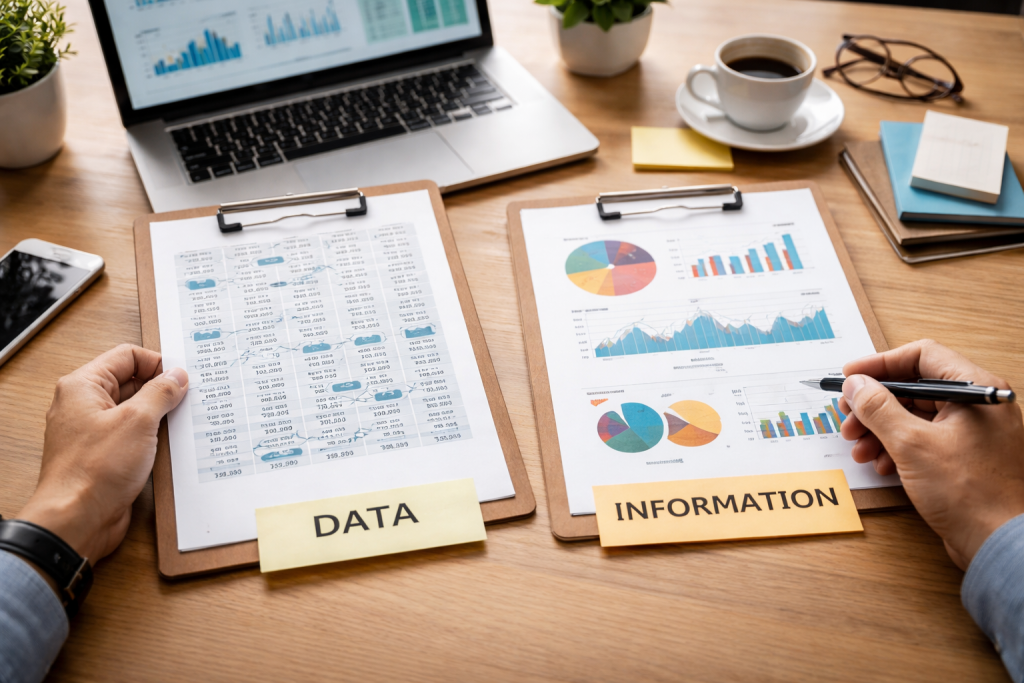
The modern world is awash in a seemingly endless deluge of facts, figures, and observations. From the smallest sensor reading to the most complex financial report, we are constantly bombarded with raw material. Yet, despite this abundance, true understanding often remains elusive. This is because there’s a fundamental distinction between the raw elements we collect and the meaningful insights we derive from them. Navigating this landscape requires a clear grasp of the difference between data and information – two terms often used interchangeably but possessing crucial, separate identities.
At its core, the journey from raw facts to actionable knowledge begins with a precise understanding of what each term represents. This foundational distinction is paramount for anyone seeking to leverage insights from the vast repositories of numbers and observations that define our current era.
Contents
- 0.1 What is Data?
- 0.2 What is Information?
- 0.3 Characteristics and Attributes
- 0.4 Purpose and Functionality
- 0.5 Laying the Foundation for Insight
- 0.6 Supporting and Validating Decisions
- 0.7 Processing and Analysis Techniques
- 0.8 Contextualization and Visualization
- 0.9 The Ramifications of Poor Data Quality
- 0.10 Strategies for Ensuring Data Integrity
- 0.11 Advanced Analytical Tools and Platforms
- 0.12 Artificial Intelligence and Machine Learning in Data Interpretation
- 0.13 Business Transformation and Competitive Advantage
- 0.14 Societal Shifts and Ethical Considerations
- 1 FAQs
- 1.1 1. What is the difference between data and information?
- 1.2 2. How does data play a role in decision-making?
- 1.3 3. Why is data quality and accuracy important?
- 1.4 4. How can technology be leveraged to analyze and interpret data?
- 1.5 5. What are the implications of data and information in the digital age for businesses and society?
What is Data?
Data, in its simplest form, refers to raw, unorganized facts, figures, symbols, or observations. These elements lack inherent meaning on their own. Think of them as individual building blocks scattered across a construction site. They don’t tell a story, provide a context, or offer any immediate value without further processing. Examples of data include a single temperature reading (“25°C”), a list of names without any associated details (“John, Sarah, Michael”), an uninterpreted audio recording, or a pixel in an image. Its nature is fragmented and often decontextualized. It exists purely as a representation of a phenomenon or a characteristic, waiting for a purpose. Without context, a number like “10” is just a character; it could represent a quantity, a duration, a score, or an identifier. It’s the “what” without the “why” or “how.”
What is Information?
Information, on the other hand, is data that has been processed, organized, structured, or presented within a given context to make it meaningful and useful. It’s the result of applying logic, analysis, and interpretation to raw data. Carrying on with our construction analogy, information is when those individual building blocks are assembled into a recognizable structure, like a wall or a doorway. Now, they serve a purpose and contribute to a larger design. The temperature reading “25°C” becomes information when it’s categorized as “room temperature,” or seen in the context of a climate control system indicating a desired setting. The list of names “John, Sarah, Michael” becomes information when it’s part of an employee roster showing their departments and roles. Information provides answers to specific questions, reveals patterns, and helps to reduce uncertainty. It transforms inert facts into valuable insights, enabling understanding and communication.
The distinctions between data and information extend beyond their basic definitions, impacting their characteristics, purpose, and utility. Recognizing these variances is critical for anyone involved in data management, analysis, or decision-making processes.
Characteristics and Attributes
Data is often quantitative (numerical) or qualitative (descriptive) but always raw and unprocessed. It can be collected from various sources, such as sensors, surveys, sales records, or logs. It has no inherent structure or context that makes it immediately applicable. Picture a hard drive filled with billions of binary code sequences; that’s raw data.
Information, conversely, possesses attributes like relevance, timeliness, accuracy, completeness, and clarity. It is organized, structured, and presented in a way that allows for interpretation. Information is derived from data and adds value by providing meaning and context. When that binary code is compiled into an executable program, displayed on a screen as text, or rendered as an image, it becomes information. It answers questions like “What happened?”, “Who is involved?”, or “When did it occur?”.
Purpose and Functionality
The primary purpose of data is simply to exist as a record of an event or characteristic. It serves as the foundation upon which knowledge and understanding are built. Data is the ingredient in the recipe.
The purpose of information is to inform, educate, influence decisions, and facilitate understanding. It is the finished dish, ready to be consumed and enjoyed. Information helps individuals and organizations make informed choices, observe trends, and predict future outcomes. It serves as a tool for communication and comprehension, enabling effective planning and execution.
In today’s complex world, sound decisions are rarely based on intuition alone. Instead, they are increasingly rooted in the systematic analysis of available evidence. This is where data steps into a pivotal role, serving as the essential raw material for informed choices.
Laying the Foundation for Insight
Before any decision, big or small, can be made with a degree of confidence, there must be a collection of relevant facts. This is the domain of data. Whether it’s sales figures, customer demographics, website traffic logs, or scientific measurements, data provides the objective baseline that prevents assumptions and biases from dominating the decision-making process. Without this foundational layer, decisions are akin to shooting in the dark – potentially lucky, but more often misguided. Data ensures that the starting point for any strategic move is grounded in reality, offering a picture of the current state or past performance.
Supporting and Validating Decisions
Beyond merely providing a foundation, data acts as a powerful tool for supporting and validating decisions post-factum. By collecting data before and after an intervention, such as launching a new product or changing a marketing strategy, organizations can quantitatively assess the impact of their choices. This feedback loop is crucial for continuous improvement. If a marketing campaign aims to increase brand engagement, data on social media interactions, website visits, and sales conversions will either validate the effectiveness of the campaign or highlight areas where adjustments are needed. In this sense, data doesn’t just inform; it also performs an auditing function, holding decision-makers accountable and promoting a culture of evidence-based management.
The journey from raw data to valuable insight is not automatic. It requires deliberate effort, sophisticated tools, and a clear understanding of the desired outcome. This transformation is where true value is unlocked.
Processing and Analysis Techniques
The first step in transforming data is processing. This involves cleaning the data (removing errors, duplicates, and inconsistencies), organizing it into a structured format (databases, spreadsheets), and potentially aggregating or disaggregating it as needed. Once processed, various analytical techniques can be applied. Descriptive analytics tells us what happened (e.g., “sales increased by 10% last quarter”). Diagnostic analytics explains why it happened (e.g., “the sales increase was due to a successful new product launch”). Predictive analytics attempts to forecast what will happen (e.g., “sales are projected to increase by another 5% next quarter”). Finally, prescriptive analytics recommends actions to take (e.g., “to maximize sales, launch a similar product in the coming quarter”). These techniques, often employing statistical methods, machine learning, and artificial intelligence, extract patterns, trends, and relationships that are otherwise hidden within the raw data.
Contextualization and Visualization
Raw analyzed data is still just numbers and figures. To become actionable information, it must be presented in a way that is easily understandable and relevant to the decision-maker. This is where contextualization and visualization become crucial. Context means putting the processed data into perspective – relating it to business goals, historical benchmarks, industry standards, or specific user needs. For instance, knowing that “sales increased by 10%” is useful, but it becomes actionable information when contextualized with the knowledge that the industry average was 15% (indicating underperformance) or that the company goal was 8% (indicating overperformance).
Visualization involves presenting information graphically through charts, graphs, dashboards, and infographics. A well-designed visual can convey complex patterns and trends far more effectively than a table of numbers. It highlights key insights, makes comparisons easy, and draws attention to critical areas, enabling quick comprehension and fostering more informed decision-making. The goal is to make the information intuitive, allowing users to grasp the meaning and implications without extensive effort.
The entire edifice of information, and the decisions based upon it, rests precariously on the quality of its foundation: the data. If the data is flawed, inaccurate, or incomplete, even the most sophisticated analytical techniques will yield misleading or erroneous information, leading to potentially disastrous outcomes.
The Ramifications of Poor Data Quality
Poor data quality can manifest in numerous ways: outdated records, typographical errors, missing values, duplicate entries, inconsistent formats, or data collected using unreliable methods. The ramifications of such deficiencies are far-reaching. Inaccurate customer data can lead to failed marketing campaigns, frustrating customer experiences, and eroded trust. Faulty financial data can result in incorrect reporting, poor investment decisions, and regulatory non-compliance. In manufacturing, flawed sensor data could lead to production delays, product defects, or costly equipment failures. In healthcare, incorrect patient records can have life-threatening consequences. The adage “garbage in, garbage out” perfectly encapsulates this principle; no amount of processing can magically transform erroneous data into reliable information. In fact, complex analysis of poor data often amplifies the errors, making them even more insidious and harder to detect.
Strategies for Ensuring Data Integrity
Ensuring data integrity is not a one-time task but an ongoing commitment requiring systematic strategies. Firstly, data validation at the point of entry is essential, using rules and controls to prevent incorrect data from being recorded. Secondly, data cleansing and enrichment processes regularly identify and fix errors, remove duplicates, and update outdated information. This can involve automated tools as well as manual review. Thirdly, establishing clear data governance policies defines roles, responsibilities, and procedures for data collection, storage, retention, and usage. This includes setting standards for data formats and definitions. Fourthly, data auditing and monitoring routinely assess data quality, tracking metrics like error rates and completeness. Finally, fostering a culture of data awareness and responsibility across the organization encourages all employees to value data accuracy and contribute to its maintenance. Investing in data quality is not an expense but an investment in the reliability of information and the soundness of future decisions.
The sheer volume and velocity of data generated in the digital age render manual analysis impractical, if not impossible. Technology has become an indispensable partner in the quest to transform vast datasets into meaningful, actionable information.
Advanced Analytical Tools and Platforms
A suite of sophisticated analytical tools and platforms has emerged to meet the challenges of modern data environments. These include robust database management systems (like SQL and NoSQL databases) for storing and organizing vast quantities of data efficiently. Business Intelligence (BI) tools (e.g., Tableau, Power BI) provide dashboards, reporting features, and interactive visualizations that allow users to explore and understand data trends without deep technical expertise. For more advanced analysis, statistical software packages (e.g., R, SPSS) and machine learning frameworks (e.g., TensorFlow, PyTorch) are employed to build predictive models, identify complex patterns, and conduct deep dives into relationships within data. Big data technologies like Hadoop and Spark are designed to process and analyze extremely large datasets that traditional tools cannot handle. These platforms automate many of the tedious aspects of data preparation and analysis, allowing humans to focus on interpretation and strategic insights.
Artificial Intelligence and Machine Learning in Data Interpretation
Artificial Intelligence (AI) and Machine Learning (ML) are revolutionizing how data is interpreted, moving beyond simple statistical analysis to uncover deeper, more nuanced insights. ML algorithms can identify patterns, anomalies, and correlations in data that would be imperceptible to humans. For example, in customer behavior analysis, ML can predict churn risk, recommend products, or segment customers based on subtle behavioral cues. In cybersecurity, AI can detect sophisticated threats by analyzing network traffic for unusual patterns. Natural Language Processing (NLP), a branch of AI, allows machines to interpret unstructured text data from customer reviews, social media, and internal documents, extracting sentiment, topics, and entities. These technologies don’t just process data; they learn from it, improving their interpretations over time. They augment human capabilities, providing powerful lenses through which to view and make sense of the overwhelming flow of data, transforming it into truly intelligent information and informed predictions. This symbiotic relationship between human analysts and intelligent machines is defining the future of data interpretation.
The pervasive nature of data and the transformative power of information in the digital age have profound implications, reshaping everything from individual experiences to global economics and societal structures.
Business Transformation and Competitive Advantage
For businesses, the ability to effectively manage, analyze, and leverage data has become a critical differentiator and a cornerstone of competitive advantage. Companies that master this skill can identify new market opportunities, optimize operational efficiencies, personalize customer experiences, and innovate rapidly. Data-driven decision-making allows for targeted marketing campaigns, precise resource allocation, and proactive risk management. For example, e-commerce giants use vast amounts of customer data to recommend products, leading to increased sales and customer satisfaction. Logistics companies optimize delivery routes based on real-time traffic and weather data, reducing costs and improving efficiency. Financial institutions employ data analytics to detect fraud and assess credit risk more accurately. Businesses that fail to embrace this data-centric approach risk falling behind, as competitors harness insights to outmaneuver them in an increasingly intelligent marketplace. This era demands a strategic investment in data infrastructure, analytical talent, and a culture that values insights derived from information.
Societal Shifts and Ethical Considerations
Beyond the commercial realm, the proliferation of data and information significantly impacts society as a whole, introducing both unprecedented opportunities and complex challenges. On the one hand, data is a powerful engine for social good. It drives scientific research, leading to breakthroughs in medicine, climate science, and urban planning. Governments use data to improve public services, optimize traffic flow, enhance public safety, and inform policy-making. Education benefits from data analytics that personalize learning experiences and identify struggling students. Citizen science initiatives leverage crowd-sourced data to advance research.
However, this data abundance also brings significant ethical considerations and societal shifts. Privacy concerns are paramount, as vast amounts of personal data are collected, processed, and stored, raising questions about surveillance and data breaches. Algorithmic bias is another critical issue, where errors or biases in the data used to train AI models can lead to discriminatory outcomes in areas like hiring, credit scoring, or criminal justice. This highlights the need for diverse and representative datasets. The spread of misinformation and disinformation, amplified by social media algorithms, poses a threat to democratic processes and public discourse. Furthermore, the digital divide can exacerbate inequalities, as access to data and the skills to interpret it become increasingly vital for economic and social mobility. Addressing these implications requires robust regulatory frameworks, ethical guidelines for data usage, investment in data literacy, and a continuous societal dialogue about the responsible deployment of these powerful tools. The digital age is not just about collecting more data; it’s about using that data intelligently, ethically, and for the collective good.
FAQs
1. What is the difference between data and information?
Data refers to raw facts and figures, while information is the processed and organized data that has meaning and context.
2. How does data play a role in decision-making?
Data provides the foundation for decision-making by offering insights, trends, and patterns that can be used to inform and support strategic choices.
3. Why is data quality and accuracy important?
High-quality and accurate data ensures that the information derived from it is reliable and trustworthy, which is crucial for making informed decisions.
4. How can technology be leveraged to analyze and interpret data?
Technology such as data analytics tools and software can be used to process, analyze, and interpret large volumes of data to extract valuable insights and trends.
5. What are the implications of data and information in the digital age for businesses and society?
In the digital age, businesses and society are increasingly reliant on data and information for decision-making, innovation, and problem-solving, leading to a greater emphasis on data-driven strategies and practices.
Welcome to The Tech Instruct, your trusted platform for simple, practical, and beginner-friendly technology learning.